





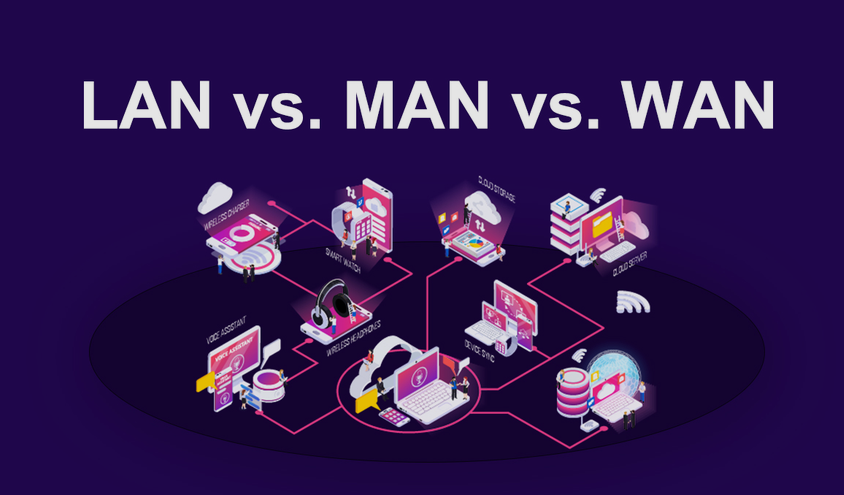
Computer networks are an essential part of modern technology. Whether you are using Wi-Fi at home, accessing files in an office, watching videos online, or connecting to a website hosted in another country, some type of computer network is working in the background.
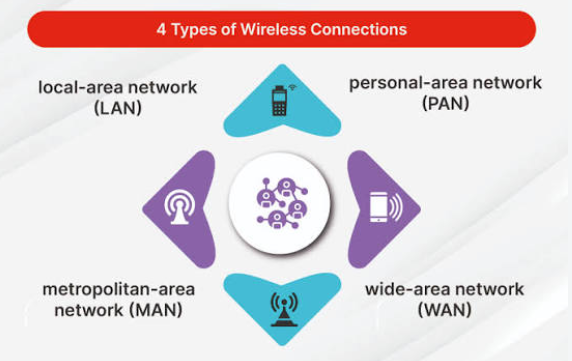
Networks can be classified in different ways, but one of the most common classifications is based on geographical coverage. The three important types are LAN, MAN, and WAN. These terms describe networks ranging from a small home or office network to systems that can connect computers across countries and continents.
Understanding the difference between LAN vs WAN vs MAN is useful for students, IT professionals, business owners, and anyone who wants to understand how computer networking works.
In this guide, we will explain what LAN, MAN, and WAN are, how they work, their advantages and disadvantages, common examples, and the major differences between them.
What Is a Computer Network?
A computer network is a group of computers, smartphones, servers, networking devices, and other connected systems that communicate with each other.
The main purpose of networking is to allow devices to share information, resources, applications, and services.
For example, when several computers in an office use the same printer, they may be connected through a local network. Similarly, when a smartphone connects to a website located on a server in another country, data travels through multiple networks before reaching its destination.
Computer networks can be classified according to their size, geographical coverage, architecture, communication method, and purpose.
LAN, MAN, and WAN are primarily classified according to geographical coverage.
What Is LAN?
LAN stands for Local Area Network.
A LAN is a network that connects computers and other devices within a relatively small geographical area. It is commonly used in homes, schools, offices, laboratories, small businesses, and individual buildings.
A LAN allows connected devices to communicate and share resources efficiently.
For example, imagine an office with 20 computers, several printers, Wi-Fi access points, and a file server. If all these devices are connected within the office building, they may form a LAN.
A home Wi-Fi network is another simple example of a LAN. Your laptop, smartphone, smart TV, printer, and other devices can all communicate through the same local network.
How Does LAN Work?
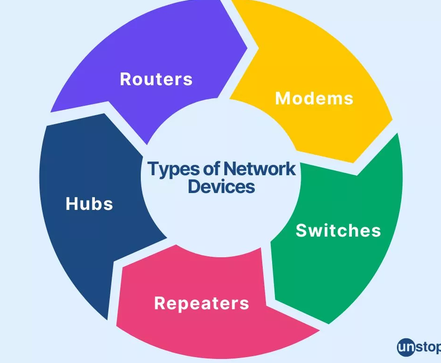
A LAN generally uses networking devices such as:
- Routers
- Ethernet switches
- Wireless access points
- Network cables
- Network interface cards
- Servers
Devices may connect using wired Ethernet connections or wireless Wi-Fi connections.
In a wired LAN, computers are often connected to a switch using Ethernet cables. The switch forwards network traffic between devices.
A router may connect the LAN to the internet or another network.
In a wireless LAN, devices communicate through Wi-Fi access points or wireless routers.
Examples of LAN
Common examples include:
- Home Wi-Fi networks
- School computer labs
- Office networks
- Small business networks
- Hospital department networks
- University classrooms
- Computer gaming networks
- Small server environments
Advantages of LAN
LANs offer several benefits.
1. High Speed
Because devices are located relatively close together, LANs can provide high data transfer speeds, particularly when modern Ethernet or Wi-Fi technologies are used.
2. Resource Sharing
Users can share printers, storage, files, applications, and internet connections.
3. Easy Management
A small LAN is generally easier to configure and manage than a large geographically distributed network.
4. Lower Cost
LANs can often be built using relatively affordable networking equipment.
5. Better Collaboration
Employees and users can quickly exchange files and communicate with shared systems.
Disadvantages of LAN
Despite its advantages, LAN also has limitations.
- It covers a relatively small geographical area.
- Network administration may require technical knowledge.
- A network failure can affect many connected users.
- Security must be properly configured to prevent unauthorized access.
- Adding many devices can increase network management complexity.
What Is MAN?
MAN stands for Metropolitan Area Network.
A MAN is a network that covers a larger geographical area than a LAN but is generally smaller than a WAN.
The word “metropolitan” refers to a city or metropolitan region. A MAN may connect multiple buildings, offices, campuses, or locations across a city.
For example, a university may have several campuses distributed throughout a city. The organization could connect those locations using a MAN.
Similarly, a government organization might connect several offices located throughout the same metropolitan area.
How Does MAN Work?
A MAN can connect multiple LANs together.
Imagine a company has three offices located in different parts of the same city. Each office may have its own LAN. A MAN can provide connectivity between those LANs.
MANs may use technologies such as:
- Fiber-optic connections
- Ethernet
- Wireless links
- Microwave connections
- Metro Ethernet
- Service-provider networks
The exact technology depends on the organization, distance, budget, and network requirements.
Examples of MAN
Examples can include:
- A city-wide university network
- A company’s offices across one city
- Municipal government networks
- Networks connecting multiple hospital buildings
- Metropolitan broadband networks
- Cable television provider networks across a city
Advantages of MAN
1. Larger Coverage Than LAN
MAN can connect locations spread across a city or metropolitan region.
2. High-Speed Connectivity
Fiber-based metropolitan networks can provide high-speed communication between different locations.
3. Resource Sharing
Organizations can share servers, databases, applications, and other resources between different buildings.
4. Centralized Management
A properly designed MAN can allow an organization to manage communication between multiple locations from a central infrastructure.
5. Useful for Large Organizations
Businesses, universities, government organizations, and healthcare systems can benefit from connecting multiple nearby locations.
Disadvantages of MAN
MAN also has some disadvantages.
- It is more expensive than a typical LAN.
- Installation can require specialized equipment.
- Network management is more complicated.
- Infrastructure may depend on telecommunications providers.
- Security becomes more important as more locations are connected.
- Physical damage to network infrastructure can affect multiple sites.
What Is WAN?
WAN stands for Wide Area Network.
A WAN is a network that covers a large geographical area. Unlike a LAN, which usually operates within a building or small area, a WAN can connect networks across cities, countries, or continents.
The internet is the world’s most well-known example of a WAN.
A multinational company may also operate a private WAN to connect offices in different countries.
For example, a company could have offices in Pakistan, the United Arab Emirates, the United Kingdom, and the United States. Each office may operate its own LAN, while a WAN connects those separate networks.
How Does WAN Work?
WANs use various communication technologies to connect distant locations.
These can include:
- Fiber-optic networks
- Leased lines
- MPLS
- VPN connections
- Cellular networks
- Satellite communication
- Internet connections
- Microwave links
WAN communication usually involves multiple networking devices and service providers.
Routers are particularly important in WAN environments because they help forward data between different networks.
Examples of WAN
Common examples include:
- The internet
- International corporate networks
- Bank networks connecting branches
- Airline reservation networks
- Cloud service networks
- Government networks connecting distant offices
- Global university networks
- Multinational company networks
Advantages of WAN
1. Very Large Coverage
WAN can connect networks across cities, countries, and continents.
2. Global Communication
Businesses can connect employees and offices located thousands of kilometers apart.
3. Centralized Services
Companies can allow multiple branches to access centralized applications, databases, and servers.
4. Remote Access
Employees can access company resources from different locations using technologies such as VPNs.
5. Supports International Businesses
WANs are essential for organizations that operate in multiple geographic locations.
Disadvantages of WAN
WANs also have significant challenges.
- They are more expensive to operate than LANs.
- Network performance can depend on service providers.
- Troubleshooting can be complicated.
- Security risks are greater because data travels across larger networks.
- Long-distance communication can introduce latency.
- Network failures can affect geographically distributed operations.
LAN vs MAN vs WAN: Main Difference
The biggest difference between LAN, MAN, and WAN is geographical coverage.
A LAN covers a small area, a MAN generally covers a metropolitan area, and a WAN covers a very large geographical area.
LAN vs MAN vs WAN Comparison Table
| Feature | LAN | MAN | WAN |
|---|---|---|---|
| Full Form | Local Area Network | Metropolitan Area Network | Wide Area Network |
| Coverage | Small area | City or metropolitan area | Very large geographical area |
| Typical Location | Home, office, building | City or multiple nearby locations | Countries or continents |
| Speed | Generally high | Generally high | Varies |
| Cost | Low to moderate | Moderate to high | High |
| Ownership | Usually private | Private or service provider | Often involves multiple providers |
| Example | Office network | City-wide university network | Internet |
| Complexity | Low | Medium | High |
| Main Purpose | Local connectivity | Connecting nearby networks | Connecting distant networks |
Difference in Geographical Coverage
Geographical coverage is the easiest way to distinguish the three.
A LAN normally operates within a limited area such as a room, home, building, or campus.
A MAN can connect several LANs across a city or metropolitan region.
A WAN can connect networks across large distances, including different cities, countries, and continents.
The boundaries are not always fixed. Modern networking technologies can make the distinction less rigid, but the basic geographical concept remains useful.
Difference in Speed
Network speed depends on the technology being used, so it is not correct to say that every LAN is always faster than every WAN.
However, LANs often provide high speeds because devices are located close together and organizations can control the local infrastructure.
MANs can also provide very high speeds, especially when fiber-optic connections are used.
WAN performance varies considerably. A private enterprise WAN using dedicated fiber may perform very differently from a WAN connection operating over a public internet connection.
Therefore, speed should be considered together with the underlying technology rather than network category alone.
Difference in Cost
LAN is generally the least expensive of the three to establish.
A small home LAN might require only a wireless router and a few cables or wireless devices.
A business LAN may require switches, access points, firewalls, servers, structured cabling, and professional administration.
MANs are more expensive because they cover larger areas and may require connections between multiple buildings.
WANs can be the most expensive, particularly for organizations requiring dedicated connections, redundant infrastructure, international connectivity, advanced security, and professional network management.
Difference in Ownership
LANs are commonly owned and controlled by an individual, business, school, or organization.
MAN ownership can vary. An organization may operate its own metropolitan network, or connectivity may be provided by a telecommunications company.
WANs are often more complex because they can involve multiple organizations and service providers.
The internet is an excellent example. It is not owned by a single company or organization. Instead, it is made up of interconnected networks operated by many different entities.
Difference in Security
Security is important for all three types of networks.
LAN security may involve:
- Wi-Fi passwords
- Firewalls
- Network access controls
- User authentication
- Device security
- VLANs
MAN security becomes more complicated because multiple locations are connected.
WAN security is particularly important because data may travel across public or third-party infrastructure.
Organizations may use:
- VPNs
- Encryption
- Firewalls
- Intrusion detection systems
- Access control
- Authentication
- Network segmentation
A secure network requires both technical controls and good security practices.
LAN, MAN, and WAN Examples in Real Life
Understanding practical examples makes the differences easier to remember.
Example 1: Home Network
A family has a Wi-Fi router connected to the internet. Smartphones, laptops, smart TVs, and printers connect to the router.
The network inside the home is a LAN.
The internet connection takes that LAN into a much larger network.
Example 2: University
A university has multiple buildings across a city. Each building has its own LAN.
The university connects those buildings using high-speed links.
The larger connection between the locations can function as a MAN.
Example 3: International Company
A company has offices in several countries. Each office has its own LAN.
The company connects these locations using a WAN.
Employees can access centralized systems and communicate between offices.
Example 4: Internet
Your home router connects your devices through a local network.
Your internet service provider then connects your network to larger networks.
Data can travel through many interconnected networks before reaching a server in another country.
The internet represents the enormous scale of WAN connectivity.
How LAN, MAN, and WAN Work Together
LAN, MAN, and WAN are not necessarily separate technologies that operate independently.
They can work together as layers of connectivity.
For example, consider a company with offices in several cities.
Each office may have a LAN connecting computers and printers.
The offices within the same metropolitan region may be connected through a MAN.
The company’s offices in different cities or countries may then be connected through a WAN.
This creates a hierarchy:
Devices → LAN → MAN → WAN → Global Networks
Not every organization will use all three categories, but the example demonstrates how networks can be interconnected.
Which Network Is Best?
There is no single network type that is best for every situation.
The appropriate choice depends on geographical coverage, number of users, budget, performance requirements, security needs, and organizational structure.
Choose LAN When:
- Devices are located in a small area.
- You need fast local communication.
- You want to share printers and files.
- You are building a home or office network.
- You need affordable networking infrastructure.
Choose MAN When:
- You need to connect multiple locations across a city.
- Several LANs need to communicate.
- Your organization operates multiple nearby buildings.
- High-speed metropolitan connectivity is required.
Choose WAN When:
- Locations are geographically distant.
- You need to connect offices in different cities.
- You operate internationally.
- Remote access is required.
- Multiple networks need to communicate over long distances.
LAN vs WAN vs MAN: Key Points to Remember
The easiest way to remember the differences is to focus on network size.
LAN = Local
It connects devices in a small geographical area such as a home, office, classroom, or building.
MAN = Metropolitan
It connects networks across a city or metropolitan region.
WAN = Wide
It connects networks across large geographical areas, potentially covering countries and continents.
LAN is generally easier and less expensive to manage. MAN provides connectivity between multiple locations within a metropolitan area. WAN provides long-distance connectivity and is commonly used by large organizations and the internet.
Conclusion
LAN, MAN, and WAN are three important classifications used to describe computer networks based mainly on geographical coverage.
A Local Area Network (LAN) is designed for relatively small areas such as homes, offices, schools, and individual buildings. It provides fast and efficient communication between nearby devices.
A Metropolitan Area Network (MAN) is larger and can connect multiple LANs across a city or metropolitan region. It is useful for universities, businesses, government organizations, and other institutions with multiple nearby locations.
A Wide Area Network (WAN) provides connectivity across much larger distances. It can connect cities, countries, and continents. The internet is the most recognizable example of WAN-scale networking.
The most important distinction is therefore simple: LAN connects locally, MAN connects across a metropolitan area, and WAN connects over wide geographical distances.