





Artificial Intelligence, commonly known as AI, has become one of the most important technologies in the modern world. From voice assistants and recommendation systems to self-driving vehicles and advanced chatbots, AI is increasingly becoming part of everyday life. Businesses, governments, schools, healthcare organizations, financial institutions, and technology companies are using AI to automate tasks, analyze information, improve decision-making, and create new products and services.
But how does artificial intelligence actually work? What technologies make AI possible? What are the different types of AI, and where is it being used today?
This complete guide explains how artificial intelligence works in simple terms, explores its major types, discusses common applications, and provides practical examples of AI in everyday life.
What Is Artificial Intelligence?
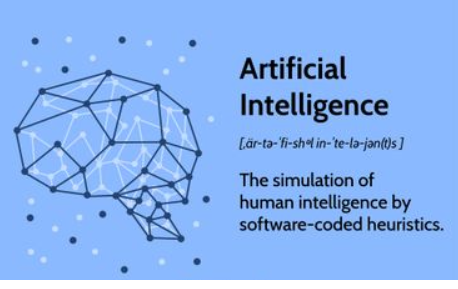
Artificial Intelligence is a branch of computer science focused on creating computer systems that can perform tasks that normally require human intelligence.
Human intelligence allows people to learn from experience, recognize patterns, understand language, solve problems, make decisions, and adapt to changing situations. AI systems attempt to perform some of these abilities using computer programs, algorithms, data, and computing power.
For example, when you ask a voice assistant a question and receive an appropriate response, AI technologies may be involved in understanding your speech and determining what you are asking.
Similarly, when a streaming service recommends a movie based on your previous viewing behavior, an AI system may analyze your activity and predict what you are likely to enjoy.
AI does not necessarily think or understand the world in exactly the same way humans do. Instead, different AI systems are designed to perform specific tasks using mathematical models and large amounts of information.
How Does Artificial Intelligence Work?
At a basic level, artificial intelligence works by combining data, algorithms, models, and computing power.
The exact process depends on the type of AI system, but many modern AI applications follow a general process.
1. Collecting Data
AI systems need information to learn patterns and make predictions.
Data can come from many sources, including:
- Text documents
- Images
- Videos
- Audio recordings
- Websites
- Sensors
- Databases
- Customer interactions
- Financial transactions
- User behavior
For example, an AI system designed to recognize cats in photographs could be trained using thousands or millions of images containing cats and other objects.
The quality of the data is extremely important. Poor-quality, incomplete, or biased data can lead to inaccurate results.
2. Preparing the Data
Raw data is often not ready to be used directly by an AI model. It may contain errors, duplicate information, missing values, irrelevant content, or inconsistent formatting.
Data preparation can involve cleaning, organizing, labeling, and transforming the information.
For example, if an AI system is being trained to recognize different types of vehicles, images may be labeled as cars, trucks, buses, motorcycles, and other categories.
The prepared data gives the AI system useful examples from which it can learn.
3. Choosing an Algorithm
An algorithm is a set of instructions or mathematical procedures used to solve a problem.
Different AI tasks require different approaches.
For example, machine learning algorithms can be used for classification, prediction, recommendation, clustering, and other tasks.
The algorithm determines how the system processes information and identifies patterns.
4. Training the AI Model
Training is one of the most important stages of modern AI.
During training, an AI model processes large amounts of data and adjusts its internal parameters to improve its performance.
Imagine training an AI system to identify whether an email is spam. The system may receive thousands of examples of spam and legitimate emails.
Initially, it may make many incorrect predictions. During training, the model compares its predictions with the correct answers and adjusts itself to reduce errors.
After repeating this process many times, the model can become much better at recognizing patterns associated with spam.
5. Testing the Model
After training, the model needs to be tested using information it has not previously seen.
This helps determine whether the AI has actually learned useful patterns or simply memorized its training data.
For example, an image-recognition model might be trained using one collection of photographs and tested using a separate collection.
A strong model should perform well on new information, not just the examples it saw during training.
6. Making Predictions or Decisions
Once an AI model has been trained, it can be used with new data.
For example, an AI fraud-detection system can examine a new financial transaction and estimate whether it appears legitimate or suspicious.
A recommendation system can analyze a user’s activity and predict which products, movies, songs, or articles may interest them.
This stage is often called inference.
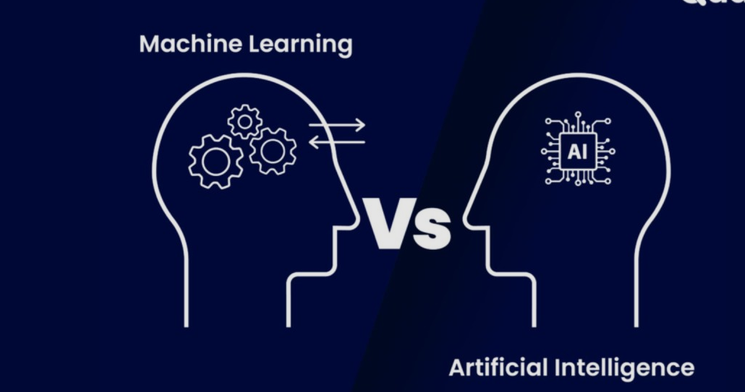
What Is Machine Learning?
Machine learning is one of the most important technologies used to build AI systems.
Instead of programming every possible rule manually, machine learning allows computers to learn patterns from data.
Traditional programming might involve explicitly telling a computer:
“If condition A happens, perform action B.”
Machine learning takes a different approach. Developers provide data and a learning method, and the system identifies patterns that can be used to make predictions or decisions.
For example, rather than manually creating thousands of rules for detecting fraudulent transactions, a machine learning system can study historical transaction data and learn patterns associated with fraud.
Machine learning is used in recommendation engines, fraud detection, search engines, image recognition, advertising systems, cybersecurity, healthcare analysis, and many other areas.
What Is Deep Learning?
Deep learning is a specialized area of machine learning that uses artificial neural networks with multiple layers.
These networks are loosely inspired by the structure of biological neural networks, although artificial neural networks are mathematical systems rather than literal copies of the human brain.
Deep learning has become particularly powerful for tasks involving large amounts of complex data.
It is widely used for:
- Image recognition
- Speech recognition
- Natural language processing
- Computer vision
- Generative AI
- Autonomous systems
- Text generation
For example, a deep learning model can analyze large collections of text and learn statistical relationships between words, phrases, and concepts.
What Are Neural Networks?
Neural networks are computational models consisting of interconnected processing units commonly called neurons.
A typical neural network includes:
- An input layer
- One or more hidden layers
- An output layer
The input layer receives information. Hidden layers process that information through mathematical operations, while the output layer produces a result.
For example, an image-recognition neural network might receive the pixels of a photograph as input. Different layers can learn increasingly complex patterns, eventually helping the system determine what objects appear in the image.
Modern deep neural networks can contain many layers and millions or even billions of adjustable parameters.
Types of Artificial Intelligence
AI can be classified in several ways. One common classification is based on the system’s capabilities.
1. Narrow AI
Narrow AI, also called weak AI, is designed to perform specific tasks.
Most AI systems available today fall into this category.
Examples include:
- Voice assistants
- Recommendation systems
- Spam filters
- Facial recognition systems
- Translation software
- AI writing tools
- Fraud detection systems
- Image-generation systems
A narrow AI system can be extremely effective at its specific task but may not have general human-like intelligence.
For example, an AI designed to recommend movies cannot automatically perform medical diagnosis, drive a vehicle, and write computer software unless it has been specifically designed and trained for those tasks.
2. General AI
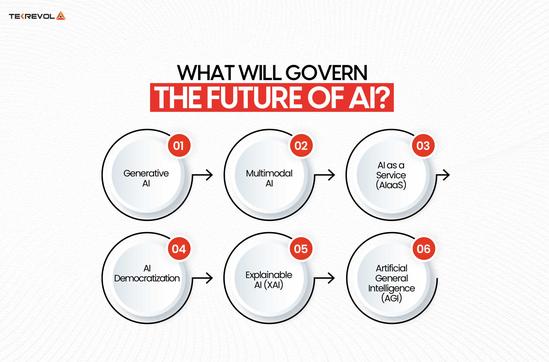
Artificial General Intelligence, or AGI, refers to a theoretical form of AI capable of performing a broad range of intellectual tasks at a human-like level.
A true AGI system would theoretically be able to learn new skills, reason across different subjects, adapt to unfamiliar situations, and transfer knowledge between tasks.
AGI remains a major research goal, but it is different from the narrow AI systems commonly used today.
3. Superintelligent AI
Artificial Superintelligence refers to a hypothetical AI system whose intellectual abilities would substantially exceed those of humans across virtually all areas.
This concept is mainly discussed in AI research, philosophy, and future-technology scenarios.
It is important to distinguish this theoretical concept from current AI products.
Types of AI Based on Learning Methods
AI can also be categorized according to how systems learn.
Supervised Learning
In supervised learning, an AI model learns from labeled examples.
For example, a dataset may contain thousands of emails labeled as either “spam” or “not spam.”
The model learns patterns from these examples and then attempts to classify new emails.
Supervised learning is commonly used for:
- Classification
- Price prediction
- Risk assessment
- Medical image analysis
- Fraud detection
Unsupervised Learning
Unsupervised learning works with data that does not have predefined labels.
The system attempts to discover patterns, relationships, or groups within the data.
For example, a business could use unsupervised learning to identify groups of customers with similar purchasing behavior.
Common applications include customer segmentation, anomaly detection, and pattern discovery.
Reinforcement Learning
Reinforcement learning involves an AI agent learning through interaction with an environment.
The system receives rewards for desirable actions and penalties or lower rewards for undesirable actions.
Over time, it learns strategies that can improve its performance.
Reinforcement learning has been used in areas such as robotics, game-playing systems, resource management, and optimization.
What Is Generative AI?
Generative AI is a type of AI capable of producing new content based on patterns learned from existing data.
It can generate:
- Text
- Images
- Audio
- Video
- Computer code
- Summaries
- Presentations
- Other forms of digital content
AI chatbots are a well-known example of generative AI. They process a user’s prompt and generate a response based on patterns learned during training and other system components.
Image-generation systems can similarly create images from written descriptions.
Generative AI has become particularly important because it allows people to interact with complex AI systems using natural language.
How AI Understands Human Language
Natural Language Processing, or NLP, is the field of AI concerned with understanding and generating human language.
NLP helps computers work with:
- Written text
- Spoken language
- Questions
- Commands
- Documents
- Conversations
Modern language models process text by breaking it into smaller units and analyzing relationships between those units.
For example, when an AI receives a question, it can analyze the words and surrounding context to determine what type of response is appropriate.
NLP powers applications such as translation tools, chatbots, search systems, grammar assistants, customer-support software, and voice interfaces.
How AI Recognizes Images
Computer vision is the field of AI that enables computers to interpret visual information.
AI-powered computer vision systems can analyze photographs, videos, medical scans, documents, and other visual content.
For example, a security system might use computer vision to identify objects or unusual activity.
A smartphone can use computer vision for facial recognition, photography improvements, document scanning, and image organization.
Computer vision is also used in manufacturing, healthcare, transportation, agriculture, and retail.
Common Uses of Artificial Intelligence
AI is now used across many industries.
AI in Healthcare
Healthcare organizations use AI for tasks such as medical image analysis, administrative automation, patient-support tools, drug research, and risk prediction.
AI can help healthcare professionals process large amounts of information more efficiently.
However, AI systems are generally intended to support professional decision-making rather than replace qualified healthcare professionals.
AI in Education
AI can personalize learning experiences by analyzing student performance and identifying areas where additional practice may be useful.
AI tools can also assist with:
- Tutoring
- Writing support
- Language learning
- Question generation
- Educational content creation
- Administrative tasks
Teachers can use AI to reduce repetitive work and develop learning materials.
AI in Banking and Finance
Financial institutions use AI for:
- Fraud detection
- Risk analysis
- Customer service
- Transaction monitoring
- Credit assessment
- Market analysis
AI can process large quantities of financial data quickly and identify unusual patterns.
AI in E-Commerce
Online stores use AI to understand customer behavior and improve shopping experiences.
Recommendation engines can suggest products based on browsing history, previous purchases, and other signals.
AI can also help businesses with inventory forecasting, customer support, product categorization, and personalized marketing.
AI in Transportation
AI is used in navigation systems, traffic management, driver-assistance technologies, logistics, and autonomous-vehicle research.
Navigation applications can analyze traffic information and suggest routes based on current conditions.
Logistics companies can use AI to optimize delivery routes and improve fleet management.
AI in Cybersecurity
Cybersecurity systems can use AI to identify unusual behavior and detect potential threats.
AI can analyze large volumes of network activity and identify patterns that may indicate malware, account compromise, or other security problems.
AI in Entertainment
Streaming platforms use AI-powered recommendation systems to suggest movies, shows, music, and other content.
AI is also increasingly being used for content creation, video editing, visual effects, game development, and music-related applications.
Everyday Examples of Artificial Intelligence
You may already use AI several times a day without realizing it.
Smartphone Face Recognition
Many smartphones use AI-powered computer vision to recognize faces and help authenticate users.
Voice Assistants
Voice assistants use speech recognition and language-processing technologies to understand spoken commands and provide responses.
Search Engines
Modern search engines use sophisticated algorithms and AI technologies to understand queries and determine relevant results.
Email Spam Filters
Email providers use machine learning to identify patterns associated with unwanted messages and automatically filter them.
Social Media Recommendations
Social platforms use algorithms and AI systems to recommend posts, videos, accounts, and advertisements based on various signals.
Online Shopping Recommendations
E-commerce platforms analyze user activity and product information to recommend items that may be relevant to a customer.
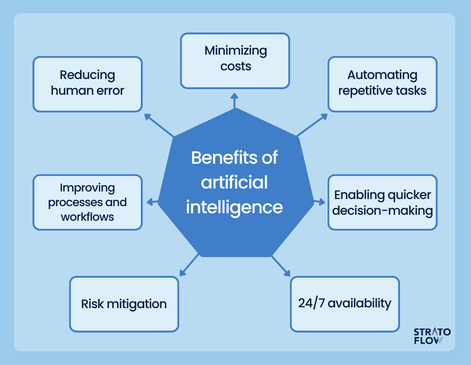
Benefits of Artificial Intelligence
AI offers several important benefits.
Automation
AI can automate repetitive tasks, allowing people to focus on more complex and creative activities.
Speed
Computers can process large amounts of information much faster than humans in many situations.
Pattern Recognition
AI can identify complex patterns in large datasets that may be difficult for people to recognize manually.
Personalization
AI can help businesses provide personalized recommendations, services, and experiences.
Availability
AI-powered systems can operate continuously without requiring traditional working hours.
Limitations of Artificial Intelligence
Despite its advantages, AI also has important limitations.
AI Can Make Mistakes
AI systems are not always correct. They can produce inaccurate predictions, incorrect classifications, or misleading information.
Dependence on Data
The quality of an AI system often depends heavily on the quality and quantity of its training data.
Bias
If training data contains biases, an AI system may reproduce or amplify those biases.
Lack of Human Judgment
AI does not necessarily understand situations in the same way humans do. Important decisions may require human judgment, context, experience, and ethical reasoning.
Privacy Concerns
AI applications can involve large amounts of personal or behavioral information, creating privacy and data-management challenges.
The Future of Artificial Intelligence
Artificial intelligence is likely to become increasingly integrated into software, workplaces, consumer products, and online services.
Future AI systems may become better at understanding complex instructions, processing multiple forms of information, assisting with professional tasks, and interacting with physical environments.
Businesses are also likely to use AI more extensively for automation, analytics, customer service, software development, marketing, research, and decision support.
At the same time, responsible AI development will remain important. Issues such as privacy, security, bias, transparency, employment, copyright, and human oversight will need continued attention.
Conclusion
Artificial Intelligence works by using algorithms, data, mathematical models, and computing power to perform tasks that traditionally require aspects of human intelligence. Modern AI commonly relies on machine learning and deep learning to identify patterns, make predictions, understand information, and generate content.
AI can be classified into different categories, including narrow AI, theoretical artificial general intelligence, and hypothetical superintelligent AI. Machine learning approaches such as supervised learning, unsupervised learning, and reinforcement learning provide different ways for systems to learn from information and interaction.
Today, AI is used in healthcare, education, finance, transportation, cybersecurity, e-commerce, entertainment, smartphones, search engines, and countless other applications.
Although AI offers significant benefits through automation, speed, personalization, and pattern recognition, it also has limitations. AI systems can make mistakes, depend on data quality, reproduce biases, and require appropriate human oversight.