





Artificial Intelligence (AI) and Machine Learning (ML) are two of the most important technologies shaping the modern digital world. They are used in smartphones, search engines, recommendation systems, healthcare, banking, cybersecurity, autonomous vehicles, customer service, content creation, and countless other industries.
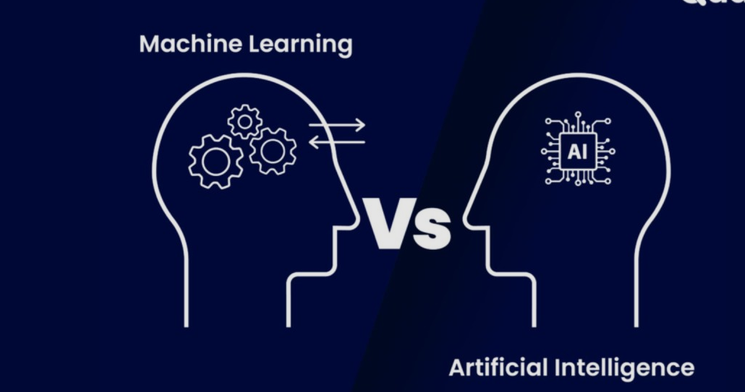
Although the terms Artificial Intelligence and Machine Learning are often used interchangeably, they do not mean exactly the same thing. Machine Learning is actually a subset of Artificial Intelligence. In simple terms, AI is the broader concept of creating machines that can perform tasks that normally require human intelligence, while ML is one of the main techniques used to make machines intelligent by allowing them to learn from data.
Understanding the difference between AI and ML can help beginners, students, business owners, and technology professionals understand how modern intelligent systems work and where these technologies are being used.
What Is Artificial Intelligence?
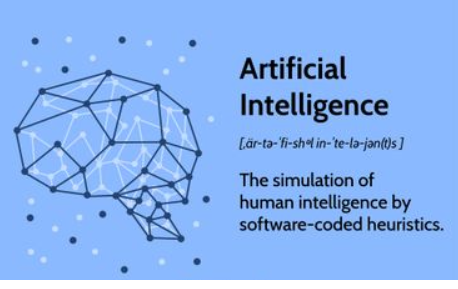
Artificial Intelligence is a broad field of computer science focused on creating systems capable of performing tasks that traditionally require human intelligence.
Human intelligence includes abilities such as:
- Learning from experience
- Understanding language
- Recognizing images and sounds
- Solving problems
- Making decisions
- Identifying patterns
- Planning actions
- Reasoning
- Adapting to new situations
AI attempts to reproduce some of these abilities using computer systems.
For example, when a virtual assistant understands a spoken question and provides an appropriate response, AI technology is involved. When a computer system analyzes thousands of medical images to identify potential abnormalities, it may also use AI.
AI does not necessarily mean that a machine thinks exactly like a human. Instead, it refers to systems designed to perform intelligent tasks.
What Is Machine Learning?
Machine Learning is a branch or subset of Artificial Intelligence that focuses on allowing computers to learn patterns from data rather than being explicitly programmed for every possible situation.
In traditional programming, a developer generally provides rules and instructions that tell a computer exactly what to do.
For example, a simple program might be instructed:
If the temperature is above 30°C, display “Hot.”
Machine Learning takes a different approach. Instead of manually creating every rule, developers provide the system with data and an appropriate learning algorithm. The system analyzes the data and identifies patterns that can be used to make predictions or decisions.
For example, an email spam detection system can be trained using thousands of emails labeled as either spam or legitimate. The machine learning model can identify characteristics associated with spam messages and use those patterns to classify new emails.
The Simple Relationship Between AI and ML
The easiest way to understand the relationship is:
Artificial Intelligence is the larger field, and Machine Learning is a part of Artificial Intelligence.
Think of AI as a large umbrella.
Under that umbrella are different technologies and approaches, including:
- Machine Learning
- Deep Learning
- Natural Language Processing
- Computer Vision
- Expert Systems
- Robotics
- Knowledge Representation
- Reasoning and Planning
Machine Learning is therefore not separate from AI. Instead, it is one of the most important methods used to develop AI systems.
A useful analogy is the relationship between vehicles and cars. A car is a type of vehicle, but not every vehicle is a car. Similarly, Machine Learning is a type of AI technology, but not every AI system necessarily uses Machine Learning.
Key Difference Between AI and Machine Learning
The primary difference is their scope.
AI is the broader concept of building intelligent machines.
ML is a specific approach that allows machines to learn from data and improve their performance.
AI focuses on the overall goal of intelligent behavior, while ML focuses on one of the methods used to achieve that goal.
For example, suppose you want to create a system that can recognize cats in photographs.
An AI-based solution could use computer vision and other techniques to accomplish the task. A machine learning solution could be trained using thousands or millions of photographs labeled “cat” and “not cat.”
After training, the ML model can analyze a new photograph and estimate whether it contains a cat.
Artificial Intelligence vs Machine Learning: Major Differences
1. Scope
AI is a broad field that covers many technologies and techniques.
Machine Learning is narrower because it specifically focuses on learning from data.
2. Main Goal
The goal of AI is to create systems capable of intelligent behavior.
The goal of ML is to enable systems to learn patterns from data and use those patterns to make predictions or decisions.
3. How Systems Work
AI systems may operate using predefined rules, logical reasoning, search algorithms, knowledge bases, or machine learning models.
ML systems generally depend heavily on training data and algorithms that identify patterns within that data.
4. Human Programming
Some AI systems can work primarily through predefined instructions.
Machine Learning reduces the need to manually program every rule because the model learns patterns from examples.
5. Adaptability
Machine Learning models can improve or adapt when they are trained with better or additional data.
Traditional rule-based AI systems may require developers to manually modify their rules.
6. Applications
AI can be used for robotics, planning, reasoning, natural language understanding, computer vision, and decision-making.
ML is commonly used for prediction, classification, recommendation, fraud detection, personalization, and pattern recognition.
Types of Artificial Intelligence
Artificial Intelligence can be categorized in several ways. One common classification divides AI into three conceptual levels.
Narrow AI
Narrow AI, also called Weak AI, is designed to perform specific tasks.
Examples include:
- Voice assistants
- Recommendation systems
- Facial recognition
- Spam filters
- Search algorithms
- Navigation systems
- Chatbots
Most AI applications available today are examples of Narrow AI.
A recommendation engine might be extremely effective at suggesting movies but unable to perform unrelated tasks outside its designed capabilities.
General AI
Artificial General Intelligence (AGI) refers to a hypothetical type of AI capable of performing a wide range of intellectual tasks at a level comparable to humans.
An AGI system would theoretically be able to learn different subjects, solve unfamiliar problems, reason across domains, and adapt to many situations.
General AI remains a major research goal rather than an ordinary technology available in everyday applications.
Superintelligent AI
Artificial Superintelligence is a hypothetical concept involving AI that would exceed human intelligence across a broad range of intellectual abilities.
This remains a theoretical idea and is frequently discussed in AI research, philosophy, and technology debates.
Types of Machine Learning
Machine Learning itself has several major approaches.
Supervised Learning
In supervised learning, the model is trained using labeled data.
For example, a company might provide a machine learning model with historical customer information where each customer is labeled as either “likely to purchase” or “unlikely to purchase.”
The model learns relationships between the input information and the known outcomes.
Common applications include:
- Email spam detection
- House price prediction
- Credit risk assessment
- Image classification
- Sales forecasting
Unsupervised Learning
In unsupervised learning, the model works with data that does not have predefined labels.
The algorithm attempts to discover hidden patterns, relationships, or groups within the data.
For example, a retail company could use unsupervised learning to divide customers into groups based on purchasing behavior.
Common applications include:
- Customer segmentation
- Anomaly detection
- Pattern discovery
- Market analysis
- Data exploration
Reinforcement Learning
Reinforcement Learning involves an agent learning through interaction with an environment.
The system receives rewards for desirable actions and penalties for undesirable actions. Over time, it learns strategies that can maximize its expected reward.
Reinforcement learning has been used in areas such as robotics, game-playing systems, optimization, and automated decision-making.
What Is Deep Learning?
Deep Learning is another important concept that is often confused with AI and ML.
The relationship can be represented as:
Artificial Intelligence → Machine Learning → Deep Learning
Deep Learning is a specialized branch of Machine Learning that uses neural networks with multiple layers.
These networks can process large and complex datasets and are particularly useful for tasks involving images, audio, video, and language.
Deep learning has contributed significantly to advances in:
- Image recognition
- Speech recognition
- Natural language processing
- Generative AI
- Autonomous systems
- Medical image analysis
Therefore, Deep Learning is not a replacement for AI or ML. It is a specialized technique within Machine Learning.
How AI and ML Work Together
In many modern applications, AI and ML work together.
Consider a virtual customer service chatbot.
The overall AI system may be designed to understand questions, determine appropriate responses, manage conversations, and perform actions.
Machine Learning models may help the system:
- Analyze user input.
- Recognize patterns in language.
- Identify the user’s intent.
- Predict an appropriate response.
- Improve performance using training data.
In this example, AI represents the broader intelligent system, while ML provides important learning capabilities.
Real-World Examples of Artificial Intelligence
AI is already present in many everyday technologies.
Virtual Assistants
Voice assistants can understand spoken commands, answer questions, provide information, and perform actions.
Recommendation Systems
Streaming platforms, online stores, and social networks can recommend content based on user behavior.
Autonomous Vehicles
Self-driving and driver-assistance technologies use AI to interpret their surroundings, identify objects, and make driving-related decisions.
Healthcare
AI can assist with medical image analysis, patient data analysis, administrative tasks, and clinical decision support.
Cybersecurity
AI systems can identify unusual behavior and potentially suspicious activities.
Robotics
Robots can use AI to navigate environments, recognize objects, interact with people, and perform physical tasks.
Real-World Examples of Machine Learning
Machine Learning is especially common in systems that make predictions or identify patterns.
Fraud Detection
Banks and payment systems can analyze transaction patterns to identify potentially suspicious transactions.
Product Recommendations
Online stores can use customer behavior and purchasing history to predict which products may interest a customer.
Spam Detection
Machine learning models can learn characteristics of unwanted emails and classify incoming messages.
Predictive Maintenance
Companies can analyze machine data to predict when equipment may require maintenance.
Personalized Content
Applications can learn from user interactions to recommend videos, music, articles, or other content.
AI vs ML in Business
Businesses use both AI and ML to automate processes, improve decision-making, and provide better customer experiences.
AI can help businesses develop intelligent systems capable of handling complex tasks.
Machine Learning can help businesses analyze large amounts of historical and real-time data.
For example, an e-commerce company might use AI for an intelligent customer support system while using ML for demand forecasting, product recommendations, fraud detection, and customer segmentation.
The combination can reduce manual work and help companies make data-driven decisions.
AI vs ML in Healthcare
Healthcare is another major area where AI and ML are being applied.
AI systems can support medical professionals by analyzing information and helping with certain decision-making processes.
Machine Learning models can be trained using large datasets to identify patterns that may be difficult to detect manually.
Potential applications include:
- Medical image analysis
- Disease risk prediction
- Drug discovery
- Patient monitoring
- Hospital management
- Personalized treatment research
- Medical documentation
These technologies are generally intended to assist healthcare professionals rather than eliminate the need for medical expertise.
AI vs ML in Finance
Financial institutions use AI and ML for many purposes.
Machine Learning can analyze transaction histories and identify unusual patterns. This can help with fraud detection and risk analysis.
AI systems can also support customer service, financial analysis, automation, and decision-support tools.
Because financial decisions can have significant consequences, organizations must carefully evaluate model accuracy, security, fairness, and regulatory requirements.
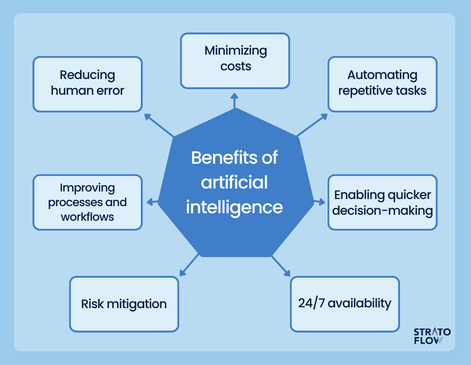
Advantages of Artificial Intelligence
AI offers several important benefits.
Automation
AI can automate repetitive and complex tasks, allowing people to focus on higher-value activities.
Faster Decision Support
AI systems can process large amounts of information quickly and provide useful insights.
24/7 Availability
Software-based AI systems can operate continuously without requiring human working hours.
Improved Personalization
AI can help companies provide personalized recommendations and experiences.
Handling Large Amounts of Data
AI can analyze information at a scale that would be difficult for humans to process manually.
Advantages of Machine Learning
Machine Learning has its own major advantages.
Learning From Data
ML models can identify patterns from large datasets.
Prediction
Machine learning can be used to forecast outcomes based on historical information.
Adaptability
Models can be retrained as new data becomes available.
Pattern Recognition
ML is particularly powerful for identifying complex relationships and patterns.
Automation
Once properly developed and deployed, ML systems can perform certain prediction and classification tasks automatically.
Limitations of AI and Machine Learning
Despite their benefits, AI and ML are not perfect.
Data Quality
Machine Learning systems often depend heavily on training data. Poor-quality, incomplete, biased, or outdated data can negatively affect results.
High Development Costs
Building sophisticated AI systems can require expensive computing infrastructure, specialized professionals, and significant development time.
Lack of Transparency
Some advanced machine learning models can be difficult to interpret, making it challenging to understand exactly why a particular prediction was produced.
Bias
If training data contains unwanted biases, models can potentially reproduce or amplify them.
Security Risks
AI and ML systems can be targeted through attacks designed to manipulate inputs, data, or model behavior.
Human Oversight
Important decisions should not automatically be delegated to AI without considering the consequences, especially in areas such as healthcare, finance, employment, and law.
Which Is More Important: AI or ML?
There is no simple answer because AI and ML serve different purposes.
AI represents the larger objective of developing intelligent systems.
Machine Learning is one of the most effective technologies for achieving that objective.
Modern AI has benefited enormously from advances in machine learning and deep learning. However, AI also includes techniques that do not necessarily involve learning from data.
Therefore, comparing AI and ML as if they are competing technologies is somewhat misleading.
It is more accurate to think of ML as one of the major tools used to build AI systems.
AI vs Machine Learning vs Deep Learning
These three terms can be summarized simply:
Artificial Intelligence: The broad field of creating machines capable of intelligent behavior.
Machine Learning: A subset of AI that allows systems to learn patterns from data.
Deep Learning: A subset of ML that uses multi-layer neural networks to learn complex patterns.
The hierarchy is:
AI
↓
Machine Learning
↓
Deep Learning
This simple structure helps explain why these terms are often mentioned together.
What Skills Are Needed to Learn AI and Machine Learning?
People interested in AI and ML can develop several useful skills.
Programming
Python is widely used for machine learning and AI development. Knowledge of programming fundamentals is an important starting point.
Mathematics
Basic knowledge of statistics, probability, linear algebra, and calculus can be helpful, especially for advanced machine learning.
Data Analysis
Understanding how to clean, organize, visualize, and analyze data is extremely valuable.
Machine Learning Algorithms
Learners should become familiar with algorithms such as linear regression, decision trees, clustering, and neural networks.
Deep Learning
After learning the fundamentals, learners can explore neural networks and deep learning.
Practical Projects
Building projects is one of the best ways to understand how AI and ML work in real-world situations.
The Future of AI and Machine Learning
AI and Machine Learning are expected to continue influencing technology, business, education, healthcare, manufacturing, transportation, and entertainment.
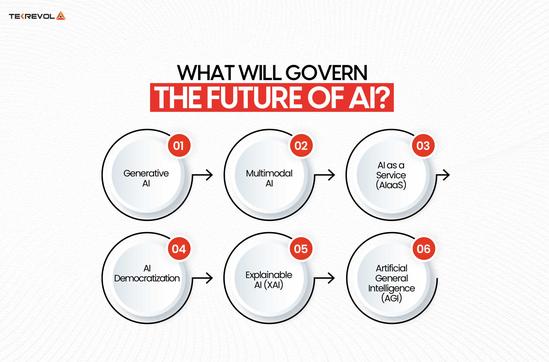
Generative AI has already demonstrated how machine learning models can create text, images, audio, software code, and other forms of content.
Future systems are likely to become more capable, efficient, and specialized. Businesses will continue looking for ways to automate workflows, analyze data, improve customer experiences, and support employees.
At the same time, responsible development will become increasingly important. Issues involving privacy, security, transparency, bias, intellectual property, and human oversight will need continued attention.
Frequently Asked Questions
Is Machine Learning the same as Artificial Intelligence?
No. Machine Learning is a subset of Artificial Intelligence. AI is the broader concept, while ML is one method used to create systems capable of intelligent behavior.
Can AI exist without Machine Learning?
Yes. Some AI systems can use predefined rules, logic, search, planning, and knowledge-based techniques without relying primarily on machine learning.
Is Deep Learning part of AI?
Yes. Deep Learning is a subset of Machine Learning, and Machine Learning is a subset of AI.
Which is easier to learn, AI or Machine Learning?
The answer depends on your background. Beginners can start with basic AI concepts and then learn machine learning fundamentals. Advanced ML can require programming, mathematics, statistics, and data analysis skills.
Is ChatGPT AI or Machine Learning?
Systems such as ChatGPT are examples of AI applications built using machine learning and deep learning techniques. They use trained models to process and generate language.
Is Machine Learning always better than traditional programming?
No. Machine Learning is useful when patterns are difficult to describe with fixed rules and sufficient data is available. Traditional programming can be simpler, cheaper, and more reliable for many well-defined tasks.
Conclusion
Artificial Intelligence and Machine Learning are closely connected, but they are not the same thing.
Artificial Intelligence is the broader field focused on creating systems capable of intelligent behavior. Machine Learning is a subset of AI that allows computers to learn patterns from data and use those patterns to make predictions or decisions. Deep Learning is a further subset of Machine Learning that uses multi-layer neural networks.
Understanding this relationship makes it easier to understand today’s technologies. From recommendation engines and spam filters to autonomous systems, healthcare applications, chatbots, and generative AI, many modern technologies rely on AI, ML, or both.
The most important point to remember is simple:
AI is the goal of creating intelligent machines, while Machine Learning is one of the major methods used to achieve that goal.
As these technologies continue to develop, understanding the difference between AI and ML will become increasingly valuable for students, professionals, businesses, and anyone interested in the future of technology.