






Artificial Intelligence, commonly known as AI, has become one of the most important technologies of the modern digital world. From smartphones and search engines to online shopping, healthcare, banking, education, and self-driving vehicles, AI is increasingly becoming part of everyday life.
You may have already interacted with artificial intelligence without realizing it. When your phone recognizes your face, a streaming platform recommends a movie, an email service filters spam, or a chatbot answers your questions, AI may be working behind the scenes.
But what exactly is Artificial Intelligence? How does it work? What are its different types, and how is it being used in the real world? Is AI going to replace human workers, and what should beginners know before learning about this technology?
This complete beginner’s guide explains Artificial Intelligence in simple terms and covers its meaning, history, types, technologies, applications, benefits, limitations, challenges, and future.
What Is Artificial Intelligence?
Artificial Intelligence is a branch of computer science focused on creating computer systems and machines that can perform tasks that normally require human intelligence.
These tasks can include:
- Understanding language
- Recognizing images and sounds
- Learning from information
- Solving problems
- Making predictions
- Identifying patterns
- Making decisions
- Generating text, images, audio, and video
- Interacting with people
In simple words, AI allows computers to perform intelligent tasks by using data, algorithms, and computational power.
Traditional computer programs usually follow instructions written specifically by programmers. AI systems can often learn patterns from large amounts of data and use those patterns to produce predictions, recommendations, or decisions.
For example, a traditional program might be instructed to identify an email containing a specific word. An AI spam filter can instead learn from thousands or millions of examples of spam and legitimate emails and determine whether a new message is likely to be spam.
How Does Artificial Intelligence Work?
AI may seem complicated, but its basic concept can be explained relatively simply.
An AI system generally works by combining data, algorithms, models, computing power, and training.
1. Data
Data is one of the most important components of modern AI.
AI systems can learn from many types of data, including:
- Text
- Images
- Videos
- Audio
- Numbers
- Documents
- Customer information
- Sensor readings
- Internet content
For example, an AI system designed to recognize cats might be trained using thousands or millions of images containing cats and other objects.
The quality and quantity of training data can have a major impact on an AI system’s performance.
2. Algorithms
An algorithm is a set of instructions or mathematical procedures used to solve a problem.
AI algorithms help computers identify patterns and relationships within data.
Different problems require different algorithms. Some are designed for classification, while others are used for prediction, recommendation, optimization, or generation.
3. Machine Learning Models
A machine learning model is a system that learns patterns from data.
Instead of programming every possible answer manually, developers provide training data and allow the model to learn relationships within that data.
For example, a model could analyze historical house prices and learn how factors such as location, size, number of rooms, and property age relate to prices.
Once trained, the model can estimate the potential price of another house.
4. Training
Training is the process through which an AI model learns from data.
During training, the system processes examples and adjusts its internal parameters to improve its results.
Training large AI models can require enormous amounts of computing power, specialized hardware, and large datasets.
5. Inference
After a model has been trained, it can be used to process new information. This process is commonly called inference.
For example, when you type a question into an AI chatbot, the trained model processes your input and generates a response.
What Is Machine Learning?
Machine Learning, or ML, is one of the most important areas of Artificial Intelligence.
Machine learning enables computers to learn patterns from data rather than relying entirely on manually programmed instructions.
There are several major types of machine learning.
Supervised Learning
In supervised learning, an AI model is trained using labeled examples.
For instance, a model may receive thousands of images labeled as:
- Cat
- Dog
- Horse
- Bird
The model learns the characteristics associated with each category. It can then classify new images.
Supervised learning is widely used for tasks such as fraud detection, image classification, forecasting, and email filtering.
Unsupervised Learning
Unsupervised learning works with data that does not have predefined labels.
The system attempts to discover patterns, groups, or relationships within the information.
For example, a company could use unsupervised learning to identify groups of customers with similar purchasing behavior.
Reinforcement Learning
Reinforcement learning involves an AI system learning through interaction with an environment.
The system receives rewards for desirable actions and penalties for undesirable actions.
Over time, it learns strategies that can increase its rewards.
Reinforcement learning has been used in robotics, games, optimization, and other complex decision-making tasks.
What Is Deep Learning?
Deep Learning is a specialized area of machine learning that uses artificial neural networks with multiple layers.
These networks are loosely inspired by the structure of biological neural networks.
Deep learning has played an important role in major advances in:
- Computer vision
- Speech recognition
- Natural language processing
- Image generation
- Video analysis
- Recommendation systems
- Autonomous systems
Deep learning models can process extremely large datasets and identify complex patterns.
For example, deep learning can help a computer system recognize objects in photographs or understand spoken language.
What Are Neural Networks?
Artificial neural networks are computational systems made up of interconnected processing units often called neurons.
A neural network typically contains:
- Input layers
- Hidden layers
- Output layers
The input layer receives information. Hidden layers process the information, and the output layer produces a result.
Modern neural networks can contain a very large number of parameters. These parameters are adjusted during training so that the model becomes better at a particular task.
Neural networks are particularly useful for complicated problems involving images, language, speech, and other forms of unstructured data.
What Is Generative AI?
Generative AI is a type of artificial intelligence designed to create new content.
Unlike systems that simply classify or predict information, generative AI can produce outputs such as:
- Text
- Images
- Music
- Audio
- Video
- Computer code
- Summaries
- Presentations
AI writing assistants can generate articles, emails, summaries, and other text. Image-generation systems can create pictures from written descriptions. Coding assistants can help developers write and understand software.
Generative AI has become one of the most visible areas of AI because people can interact with these systems using natural language.
What Are Large Language Models?
Large Language Models, commonly called LLMs, are AI models designed to process and generate human language.
They are trained on large collections of text and learn statistical patterns in language.
LLMs can perform tasks such as:
- Answering questions
- Summarizing documents
- Translating text
- Generating content
- Explaining concepts
- Writing code
- Brainstorming ideas
- Extracting information
An LLM does not understand language in exactly the same way humans do. It processes patterns and relationships within data using complex mathematical representations.
Examples of Artificial Intelligence in Everyday Life
You do not need to work in a technology company to encounter AI. It is already integrated into many everyday products and services.
Smartphones
Modern smartphones use AI for features such as:
- Face recognition
- Voice assistants
- Camera enhancement
- Predictive text
- Translation
- Photo organization
- Battery optimization
Search Engines
Search engines use sophisticated algorithms and AI technologies to understand search queries and provide relevant results.
AI can help interpret what a person means rather than simply matching individual words.
Streaming Services
Entertainment platforms use recommendation systems to analyze viewing or listening behavior.
These systems can recommend movies, television shows, music, or other content based on patterns.
Online Shopping
E-commerce websites use AI for:
- Product recommendations
- Search results
- Fraud detection
- Customer support
- Demand forecasting
- Personalized shopping experiences
AI-powered email systems can identify spam, categorize messages, detect suspicious activity, and suggest responses.
Maps and Navigation
Navigation applications can use AI and machine learning to analyze traffic patterns, estimate travel times, and recommend routes.
Artificial Intelligence in Healthcare
Healthcare is another important area where AI is being developed and used.
AI can assist healthcare professionals with:
- Medical image analysis
- Patient data analysis
- Drug discovery
- Research
- Administrative tasks
- Risk prediction
- Appointment management
- Personalized treatment research
AI can potentially help identify patterns in medical images and large datasets that may be difficult to detect manually.
However, healthcare AI requires careful validation because incorrect results can have serious consequences. AI should not automatically be treated as a replacement for qualified medical professionals.
Artificial Intelligence in Education
AI is changing the way students and teachers interact with educational technology.
AI-powered systems can provide:
- Personalized learning
- Writing assistance
- Language practice
- Automated feedback
- Study recommendations
- Educational explanations
- Question generation
For example, an AI tutor can explain a difficult concept in simpler language or provide practice questions based on a student’s learning level.
Teachers can also use AI to assist with lesson planning, content creation, and administrative work.
Artificial Intelligence in Business
Businesses across different industries are adopting AI to improve productivity and decision-making.
Common business applications include:
- Customer service chatbots
- Sales forecasting
- Marketing personalization
- Fraud detection
- Data analysis
- Document processing
- Inventory management
- Employee support
- Workflow automation
AI can process large amounts of information much faster than humans in many situations, making it useful for repetitive and data-intensive tasks.
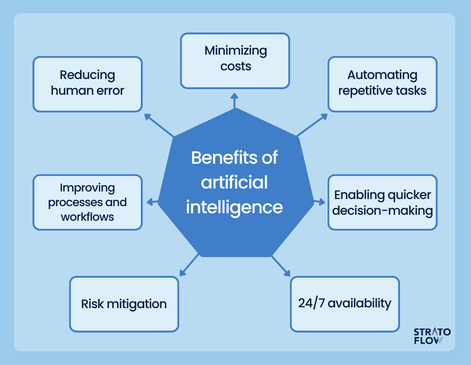
Benefits of Artificial Intelligence
AI offers several potential benefits for individuals, organizations, and society.
Increased Productivity
AI can automate repetitive tasks and allow employees to focus on more complex responsibilities.
Faster Data Analysis
Computers can process enormous amounts of information quickly, helping organizations identify patterns and trends.
Improved Personalization
AI can customize recommendations and experiences according to individual users.
Automation
Businesses can automate many routine activities, including data entry, customer support, document processing, and scheduling.
Better Decision Support
AI can analyze large datasets and provide predictions or recommendations that support human decision-making.
24/7 Availability
AI-powered systems can operate continuously without needing breaks, making them useful for customer support and automated services.
Limitations of Artificial Intelligence
Despite its capabilities, AI has important limitations.
AI Can Make Mistakes
AI systems can produce incorrect information or predictions.
Even advanced systems are not guaranteed to be accurate.
AI Depends on Data
Poor-quality, incomplete, outdated, or biased training data can negatively affect an AI system.
Lack of Human Judgment
AI does not possess human experience, emotions, values, or common sense in the same way people do.
High Development Costs
Building and operating advanced AI systems can require expensive hardware, software, data, and skilled professionals.
Privacy Concerns
AI applications may process large amounts of personal or sensitive information, creating important privacy and security considerations.
AI and the Future of Jobs
One of the biggest questions surrounding AI is whether it will replace human workers.
The answer is more complicated than simply saying yes or no.
AI is likely to automate some tasks, especially repetitive and predictable ones. At the same time, it can create new roles and change existing jobs.
Many future workplaces may involve humans and AI working together.
For example, a marketing professional might use AI to analyze customer data and generate initial content, while the human handles strategy, creativity, brand decisions, and final quality control.
Workers who learn how to effectively use AI tools may gain an advantage as businesses increasingly adopt AI technology.
AI Ethics and Responsible Development
As AI becomes more powerful, responsible development is increasingly important.
Important AI-related concerns include:
- Privacy
- Security
- Bias
- Transparency
- Copyright
- Misinformation
- Accountability
- Job displacement
- Misuse of technology
Developers and organizations need to consider how AI systems affect people.
Responsible AI development involves testing systems carefully, monitoring their performance, protecting user information, and establishing appropriate safeguards.
Common Misconceptions About Artificial Intelligence
There are many misconceptions about AI.
AI Is the Same as Human Intelligence
AI can perform impressive tasks, but that does not mean it thinks exactly like a human.
AI Always Gives Correct Answers
AI systems can make mistakes. Important information should be verified when accuracy matters.
AI Is Only for Large Companies
AI tools are increasingly accessible to individuals, students, small businesses, and independent developers.
AI Is a Single Technology
Artificial Intelligence is a broad field containing many technologies, including machine learning, deep learning, computer vision, natural language processing, robotics, and generative AI.
How Beginners Can Start Learning AI
If you are new to AI, you do not need to become an advanced programmer immediately.
A good learning path can begin with understanding the fundamentals.
Step 1: Learn Basic Computer Concepts
Understand how computers, software, networks, data, and algorithms work.
Step 2: Learn Basic Mathematics
AI and machine learning involve concepts from areas such as statistics, probability, algebra, and calculus.
Beginners do not need to master advanced mathematics immediately, but a basic understanding can become valuable later.
Step 3: Learn Programming
Python is widely used in AI and machine learning.
Beginners can start with:
- Variables
- Data types
- Conditions
- Loops
- Functions
- Lists
- Dictionaries
- Basic object-oriented programming
Step 4: Study Machine Learning
After learning basic programming, explore concepts such as supervised learning, unsupervised learning, model training, testing, and evaluation.
Step 5: Build Small Projects
Practical projects are an excellent way to understand AI.
Beginners can experiment with projects such as:
- Spam email classification
- House price prediction
- Image classification
- Recommendation systems
- Sentiment analysis
- Simple chatbots
Step 6: Explore Generative AI
Once you understand basic AI concepts, explore modern generative AI systems and learn how prompts, models, APIs, and AI applications work.
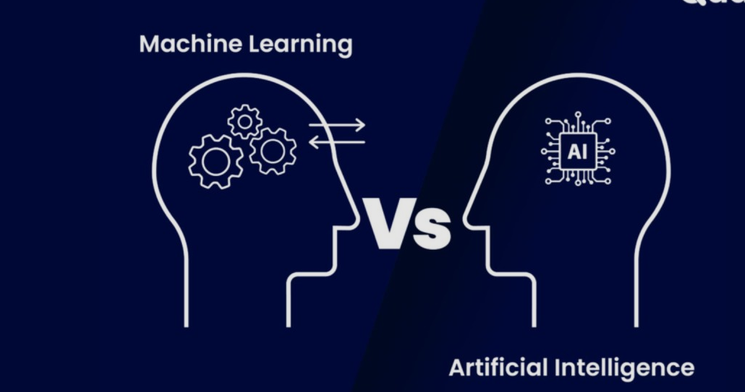
What Is the Difference Between AI, Machine Learning, and Deep Learning?
These terms are related but not identical.
Artificial Intelligence is the broad field of creating systems capable of performing tasks associated with intelligence.
Machine Learning is a subset of AI that allows systems to learn patterns from data.
Deep Learning is a subset of machine learning that uses multi-layer neural networks.
A simple way to remember the relationship is:
AI → Machine Learning → Deep Learning
Generative AI uses several advanced AI techniques and may rely on deep learning architectures to generate content.
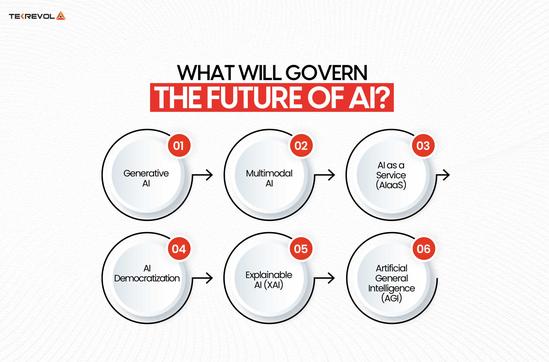
What Does the Future of AI Look Like?
Artificial Intelligence is likely to continue developing rapidly.
Future AI systems may become more capable of understanding complex instructions, processing multiple types of information, assisting professionals, automating workflows, and interacting naturally with humans.
AI may have a growing role in fields such as:
- Healthcare
- Education
- Transportation
- Software development
- Scientific research
- Manufacturing
- Finance
- Entertainment
- Cybersecurity
- Customer service
However, technological progress will also require responsible development. Society will need to consider privacy, safety, employment, misinformation, security, and other challenges.
The future of AI will likely involve collaboration between humans and intelligent software rather than simply replacing every human activity.
Final Thoughts
Artificial Intelligence is one of the most influential technologies of the modern era. It allows computers and machines to perform tasks that traditionally required human intelligence, including recognizing patterns, understanding language, making predictions, analyzing information, and generating content.
AI includes many different technologies, with machine learning and deep learning being major components. Today, AI is already used in smartphones, search engines, healthcare, education, finance, transportation, entertainment, and business.
For beginners, the most important thing is to understand that AI is not a single program or machine. It is a broad field involving data, algorithms, models, computing power, and different methods of machine learning.